 Tours to Sicily
Getting Around Sicily Without a Car: What Works
Getting around Sicily without a car works if you anchor yourself in Palermo or Catania and lean on the rail lines that link the big coastal cities. Trains cover Palermo-Cefalù, Palermo-Catania, Catania-Syracuse and Catania-Taormina with reasonable journey times. Buses fill the gaps, from Monreale on the hillside above Palermo to the fast coach that beats the train between Catania and Palermo. What the network cannot reach, day tours can: an organised seat handles Agrigento, the Godfather villages and the southeast without you touching a steering wheel. This page sorts what works from what does not, route by route, and shows where a guided day replaces a rental car. The aim is a car-free week that still feels complete. If you want the wider menu of options beyond transport, start with the full Sicily tours comparison and build outward from the routes below.
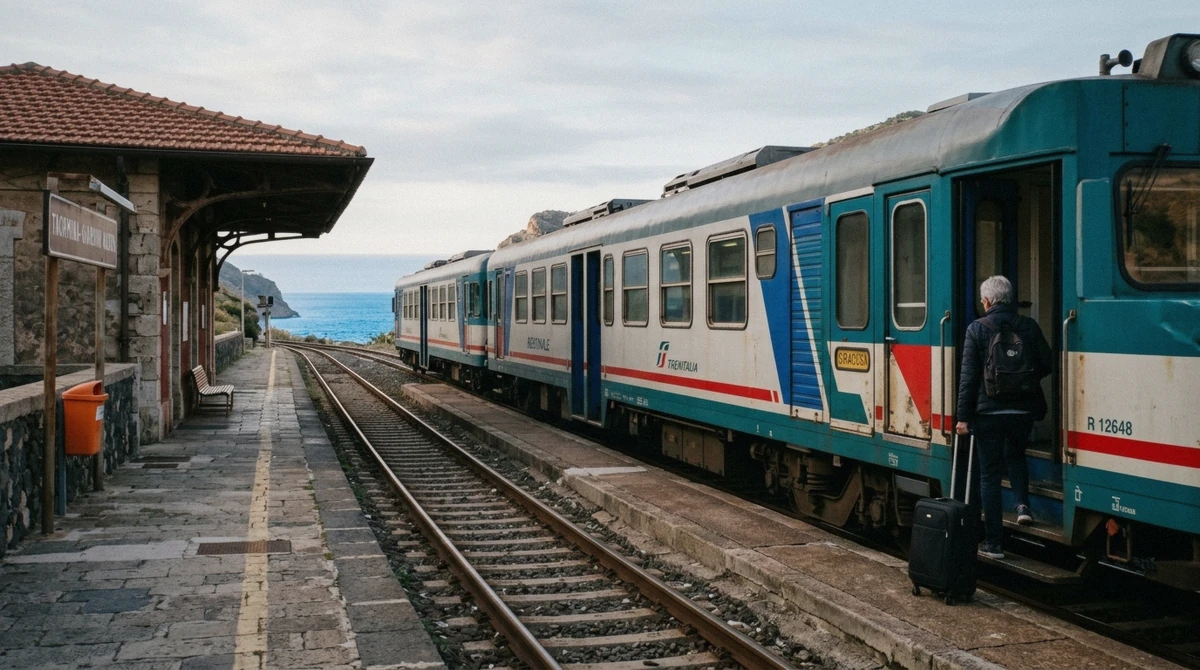
Illustrative generated image.
Quick answer Trains and buses cover the big routes, tours cover the rest
Yes, Sicily is doable without a car if you stay on the main corridors between Palermo, Cefalù, Catania, Taormina and Syracuse. Direct trains link those cities, with Palermo to Cefalù taking about 50-60 minutes and Catania to Syracuse about 1 h 15. Buses cover the routes the rails miss, including Palermo to Monreale in 20-30 minutes and a Catania-Palermo coach that runs in about 2 h 15. The gaps are real though. The Godfather villages, the Zingaro reserve and the far west have no practical public-transport loop, so a day tour or a car is the honest answer there.
Key takeaways
- Base yourself in Palermo or Catania and use direct trains for the coastal cities, as in the base-by-base itineraries.
- The Godfather filming locations tour reaches villages no bus loop can reach in a day.
- A car-free week works as base pairs, two cities in sequence. From Palermo, the day tours that work without a car fill the gaps.
Getting Around Sicily Without a Car: What Works
The honest map has three layers. The first is the rail spine. Palermo, Messina, Catania and Syracuse sit on lines that carry you between cities without a car, and the journeys are short enough to build days around.
Palermo to Cefalù takes about 50-60 minutes on direct regional trains, which makes it the island's easiest car-free day trip. Palermo to Catania runs about 2 h 50 on the direct intercity. Catania to Syracuse is about 1 h 15, and Catania to Taormina-Giardini station takes roughly 45-55 minutes.
The second layer is buses. They cover the routes the rails miss, and in one case they beat the train outright. The third layer is guided days, which act as substitute transport.
Three long-hop tours between them replace an entire driving day with a seat and a driver, and one coastal boat trip needs no road at all. Stack those layers in the right order and a week without a car stops feeling like a compromise.
The failings are specific, not general. Ride-hailing apps have patchy coverage outside Palermo and Catania. Taxis are metered but scarce outside the ranks.
The southeast runs trains, but frequencies thin out badly on Sundays. Knowing those limits in advance is the difference between a smooth car-free week and a stranded one.
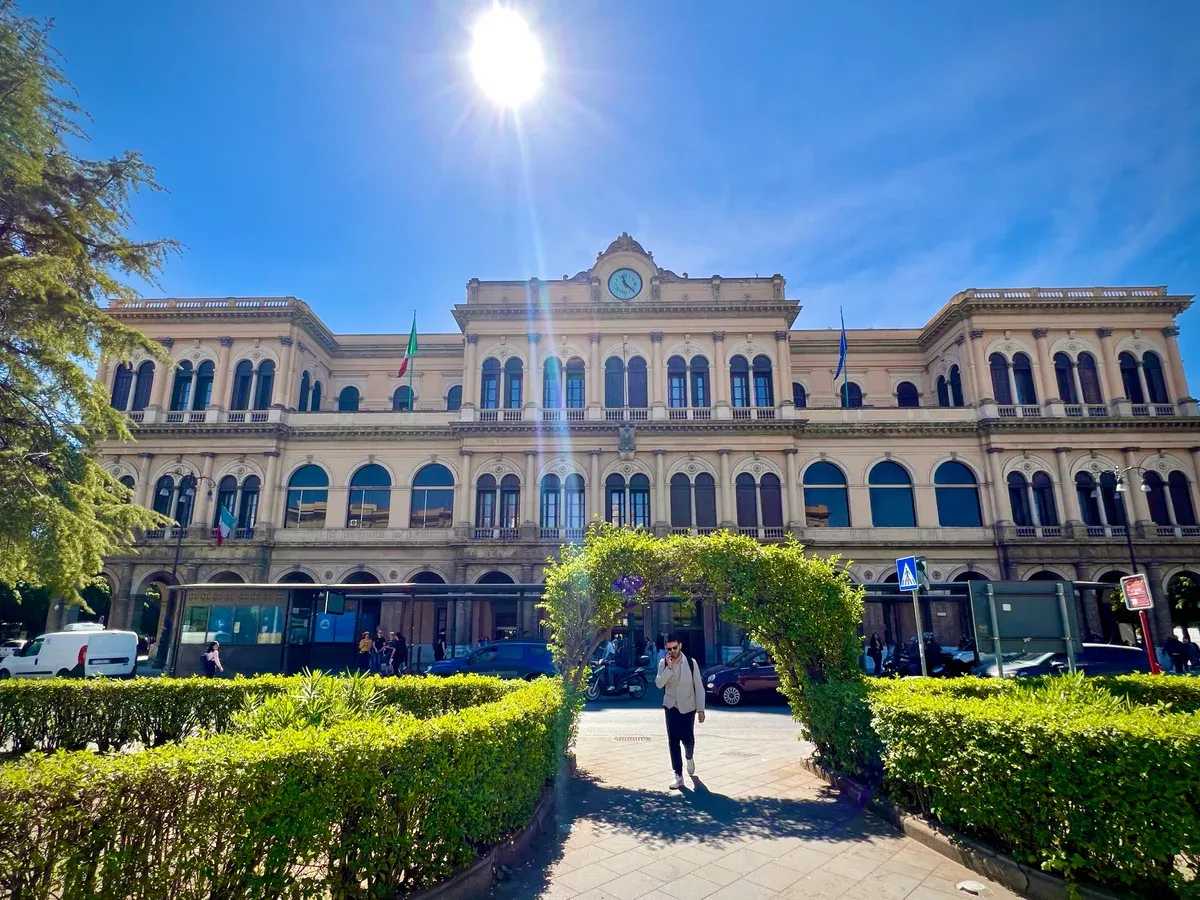
Palermo Centrale, the western anchor of the rail map. Photo: Sharon Hahn Darlin, CC BY 2.0, Via Wikimedia Commons
The Train Network: Where It Serves You
Sicily's rail map rewards travellers who pick cities on the line. Messina sits on the main line between the two coasts, about 1 h from either Palermo or Catania by the fast trains, which makes it a natural break point. Taormina has its own station at Taormina-Giardini, and Cefalù sits close enough to Palermo to work as an afternoon.
Here is the core of the network.
The core routes and times are short enough to memorise.
| Route | Service | Journey time |
|---|---|---|
| Palermo-Cefalù | Direct regional trains | About 50-60 minutes |
| Palermo-Catania | Direct intercity | About 2 h 50 |
| Catania-Syracuse | Regional trains | About 1 h 15 |
| Catania-Taormina | To Taormina-Giardini station | About 45-55 minutes |
| Messina (from either coast) | Fast trains on the main line | About 1 h |
Read that table as a day planner. Palermo-Cefalù is a morning out and back. Catania-Syracuse is a half day with room for Ortygia.
Catania-Taormina leaves the whole afternoon free once you arrive. The one weak point is frequency on the southeastern branch beyond Syracuse, where trains run but thin out on Sundays. Plan that leg for a weekday or take a guided day instead.
Buses: The Routes Trains Do Not Cover
Buses are the patch layer, and in one important case the faster option. From Palermo, the AMATA service to Monreale takes 20-30 minutes, which turns the cathedral town into an easy half day without any booking drama. Coaches also run Palermo to Trapani, reaching the coast the rail map underserves.
In Catania, airport shuttles connect the city to the terminal without a taxi.
The headline route is the Catania-Palermo coach. Asti and SAIS lines run it in about 2 h 15, often faster than the train. That single fact changes how you plan a two-base trip, because you can hop between Palermo and Catania quicker by road than by rail and keep both cities as anchors.
One caution belongs here. The southeast of the island, meaning Noto, Modica and Ragusa, does run trains, but frequencies thin out on Sundays. If your itinerary touches that corner, schedule it midweek or cover it with an organised day instead of gambling on a sparse Sunday timetable.
Ride Apps and Taxis in Sicilian Cities
Inside Palermo and Catania, ride-hailing apps work. Outside those two cities, coverage is patchy, and the apps should not form part of your plan for smaller towns. Taxis exist and are metered, but they are scarce outside the official ranks, so you cannot count on flagging one down on a quiet street.
The practical read is that city transport is a solved problem for a car-free traveller. Palermo and Catania are dense enough to walk for most daily needs, and the day trips out of both cities run on trains and buses, not on hailed rides. Budget the apps for airport runs and late evenings, and treat anything beyond the two big cities as a route that needs rails, coaches or a booked seat on a tour.
The Corners That Need a Tour or a Car
Three corners of Sicily resist public transport outright. The Godfather villages of Savoca and Forza d'Agrò, plus the Castello degli Schiavi filming location, have no practical public-transport day loop. A tour or a taxi is the way in, and a tour costs less than a day of taxis by most arithmetic. Catania/Taormina: The Godfather Filming Locations Tour runs 7 hours from Catania from $114 per person, with castle entry part of the visit, and holds a 4.9 rating across 554 reviews.
The Zingaro reserve and the far west need a car or an organised transfer. There is no bus that delivers you to the coves in time for a full day, so either rent for that leg or swap the destination for one the network serves. The far west is the one region this guide cannot patch with trains and coaches alone.
The third soft corner is the southeast on a Sunday, as the route list shows. Trains exist but frequencies thin out. None of these limits ruin a car-free trip.
They just mean you route around them, or you buy a seat on a day that handles the driving for you.
Base Pairs That Make a Car-Free Week Work
The best car-free itineraries are not one hub. They are base pairs, two cities in sequence, with a coach or train hop between them. Palermo first, then Catania, covers nearly everything the network serves.
The Catania-Palermo coach at about 2 h 15 is your transfer day, and it is often faster than the train in the other direction.
A workable split is three nights in Palermo, transfer, then three or four nights in Catania. From Palermo you reach Cefalù by train in about 50-60 minutes and Monreale by bus in 20-30 minutes, and you can fold in Agrigento on a guided day. From Catania you reach Syracuse in about 1 h 15, Taormina in about 45-55 minutes, and the Godfather villages on a booked tour.
If you are unsure how many nights each base deserves, the itineraries in How Many Days in Sicily: Itineraries From Three Days to Two Weeks lay out the options by trip length.
The pair structure also spreads risk. A Sunday in the southeast stops being a problem when your Catania days cover it midweek. And transfer days double as sightseeing, because the coach ride itself is the route.
What Day Tours Replace on the Road Map
Compare all Sicily day tours and a pattern appears. Three long-hop tours each replace a full driving day with a seat and a driver, which is exactly the function a rental car would serve in a car-free plan.
From Palermo, Palermo: Agrigento and the Valley of the Temples Day Tour runs 8 hours from $72 per person, temple entry paid separately, rated 4.2 across 2002 reviews. The Temple Valley sits outside the practical rail-and-bus day loop, so this listing is the substitute for a rental day. Palermo also has From Palermo: Monreale and Cefalù Half-Day Trip, a half-day pairing of two towns you could otherwise reach separately, with the price from $68.
From Catania, Syracuse, Ortygia and Noto Small-Group Tour from Catania runs 9 hours from $121.94 per person with lunch included and site tickets not included, rated 4.51 across 119 reviews. It sweeps the southeast in one day, dodging the Sunday frequency problem entirely. Add the Godfather day already covered above and Catania hands you three driving-day replacements from one base.
Not every tour is a transport substitute. Some are simply the day itself. Giardini Naxos, Taormina and Isola Bella Blue Grotto Boat Tour costs $40.65 per person on a shared boat for 2 hours, snorkel gear 10 euro extra, rated 4.64 across 611 reviews. The Taormina boat needs no road at all once you are on the coast.
And The Original Palermo Street Food & Market Tour is 3 hours in the city for $85.94 per person with all tastings included, rated 4.91 across 2349 reviews. Walkable, car-free, and the kind of evening that costs you nothing in logistics. Season matters for the coastal legs, and Best Time to Visit Sicily: A Month-by-Month Verdict covers the trade-offs.
The Honest Limits of Car-Free Sicily
Car-free Sicily has three honest limits. First, the far west. The Zingaro reserve and the villages beyond Trapani do not link up by public transport in a day, so that region needs a rental or a transfer.
Second, interior and hilltop sights generally sit off the rail map, which is why Agrigento needs a guided day rather than a timetable. Third, small-town evenings. Buses and regional trains thin out late, so dinner in a village means an early return or an overnight stay.
None of that makes the car-free plan a bad one. It makes it a plan with edges. Stay on the corridors, buy a seat for the corners the network misses, and accept that the far west waits for a trip with a car.
If you want a second opinion on when a guided day beats self-driving, Are Sicily Tours Worth It? An Honest Verdict weighs it directly.
Prices and times shift, so confirm the listing and the timetable before you book anything, and pack for the season with What to Wear in Sicily: The Working Packing List.
The Airport Legs: Landing Without a Rental
Both island airports connect to their cities without a car. Palermo Falcone-Borsellino sits about 35 minutes from the city by shuttle bus, running roughly every half hour, and the same services continue toward the city's rail hub. Catania Fontanarossa sits even closer, about 20 to 30 minutes from the centre along the coastal road, with the Alibus shuttle meeting most arrivals.
The airport bus is also the first test of the car-free plan, and it passes easily: tickets from the driver or the machines, luggage space over the wheels, and a stop within walking distance of both cities' historic cores. From either city centre, the train station is the gateway to everything in this guide, which is why the base-pair logic at the top of this page puts the stations first.
One airport fact changes plans for the west: Trapani-Birgi serves the low-cost carriers and sits about an hour from Trapani town by bus, which makes an open-jaw arrival, into Palermo and out of Trapani or Catania, a serious option for a fortnight that covers both coasts without doubling back.
When the Plan Needs a Car Anyway
The honest list of places a car-free Sicily does not reach well: the Zingaro reserve's coves, the far west around Marsala's lagoons and Mozia, the interior's mountain towns, and any beach that is not a town beach. None of them is on the compared tours' routes, and all of them reward either a rental for two days or the acceptance that this trip stays coastal.
The middle path works better than all-or-nothing. Rent for the interior stretch of a fortnight and return the car before the cities, or take an organised transfer day to the reserve from Palermo in summer. What does not work is a city-base rental used for day trips: the ZTL restrictions, the paid parking and the motorway tolls eat the freedom a car promises on an island whose best days are walkable.
Taxis and ride apps fill the last gaps. Palermo and Catania have ride-hailing and rank taxis. Beyond them coverage thins quickly, and the fixed-fare taxi boards at the stations are the reliable fallback.
For the Godfather villages and the Grotto coast, the compared tours in this catalog are the practical answer, because the driver, the road and the timing come as one booking.
Reading the Timetables Like a Local
Sicilian public transport keeps two rhythms, and the difference matters more than any single route. City and coastal services run to useful frequencies all day, while the regional lines to the smaller towns thin out hard after the school run and nearly vanish on Sundays. The planning rule that follows: long-hop travel days belong to mornings, and Sundays belong to the city you are standing in.
Buy before you board where you can. Regional trains sell on the platform machines and stamp on the platform validators, the intercity seats take a reservation, and the long-distance buses sell from depots and tabacchi counters rather than online in some cases. None of it is hard, and all of it is easier at ten in the morning than at six in the evening.
Strike days and schedule changes are part of the deal, announced in advance and usually limited to a day. The car-free traveller absorbs them the same way the weather gets absorbed: the compared tours' free cancellation window, standard at 24 hours, exists so that a moved timetable costs a reshuffle and not a ticket.
Luggage, Stations and the Real Walking Distances
The car-free plan lives or dies on luggage choices. Palermo Centrale and Catania Centrale both have left-luggage for the transfer days, the rolling case works on every route in this guide, and the cobbles punish anything with small wheels. Travellers moving bases by train pack for a five-minute station walk, not for a doorstep drop-off.
Station-to-old-town distances are shorter than the map suggests. Cefalù's station sits five minutes from the seafront lanes, Taormina-Giardini needs the bus or taxi up the hill rather than a walk, and Syracuse's station crosses into Ortigia in about fifteen minutes on foot. The one station that is genuinely far from its postcard is Agrigento's, which is why the temple day runs by coach and not by rail in this comparison.
The last stretch of every journey is walking, and Sicily's summer sun makes it a scheduled activity rather than an afterthought. Shaded routes exist along most of the coastal promenades, the cities' narrow streets do their own shading, and the open squares at two in the afternoon are the one walk worth deferring to four.
Getting Around Sicily Without a Car: Questions Answered
Is Sicily doable without a car?
Yes, with the right bases. Palermo and Catania between them put Cefalù, Monreale, Syracuse, Taormina and Messina within train or bus range. The gaps, mainly the Godfather villages, the Zingaro reserve and the far west, are covered by day tours or skipped.
What's the best way to get around Sicily?
Trains for the coastal cities, buses for the gaps, and day tours for the corners neither reaches. The Catania-Palermo coach at about 2 h 15 is often faster than the train, and Palermo to Cefalù takes about 50-60 minutes by direct regional train. A two-base plan built on those facts covers most itineraries.
Can you get Uber in Sicily?
Ride-hailing apps have patchy coverage outside Palermo and Catania. Inside those two cities they work, but do not plan small-town transport around them. Taxis are metered but scarce outside the ranks, so they are a backup rather than a system.
How do you get from Palermo to Catania without a car?
Two ways. The direct intercity train takes about 2 h 50, and the Asti or SAIS coach takes about 2 h 15, often faster than the train. Either works as the transfer day in a two-base itinerary.
Can you visit the Godfather villages by public transport?
No, not practically in a day. Savoca, Forza d'Agrò and the Castello degli Schiavi have no public-transport day loop, so a tour or a taxi is the way. Catania/Taormina: The Godfather Filming Locations Tour covers the route from Catania in 7 hours.
Which Sicily train routes are worth riding?
Palermo to Cefalù for the ease, about 50-60 minutes each way, and Catania to Syracuse at about 1 h 15. Catania to Taormina-Giardini at 45-55 minutes is the simplest way to the coast, and the direct intercity handles Palermo to Catania in about 2 h 50 if you prefer rails to the coach.